
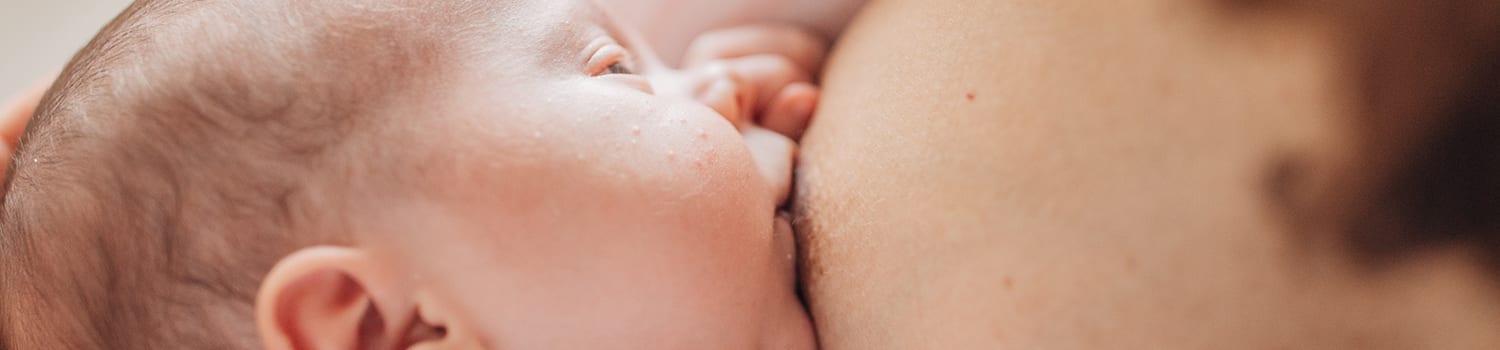
Benefits of Breastfeeding
Breastfeeding is the biological norm for infant feeding and is recommended exclusively to around 6 months, with continued breastfeeding alongside appropriate complementary foods into the second year and beyond, as desired1,2. Human milk provides optimal nutrition together with bioactive components – including immunoglobulins, human milk oligosaccharides, lactoferrin and growth factors – that support immune maturation, gastrointestinal development and healthy microbiome establishment.
Systematic reviews and umbrella reviews consistently report that breastfeeding is associated with reduced risk of gastrointestinal and respiratory infections, including lower rates of hospitalisation for acute lower respiratory infections, reduced incidence of necrotising enterocolitis in preterm infants, and modest reductions in later overweight and obesity3,4,8. For mothers, longer duration of breastfeeding is associated with reduced lifetime risk of breast and ovarian cancers, and a lower risk of type 2 diabetes and cardiovascular disease5,8.
Breastfeeding also confers economic and environmental advantages. At both household and health system levels, higher breastfeeding rates are associated with reduced healthcare utilisation and lower feeding-related expenditure8. From an environmental perspective, breastfeeding requires minimal external resources and generates little packaging or manufacturing waste. In contrast, the production and distribution of breastmilk substitutes involve agricultural activity (including dairy farming), processing, water use, energy inputs and transport, all of which contribute to greenhouse gas emissions and resource use. At a population level, breastfeeding is therefore associated with a lower environmental footprint8.
In Australia, breastfeeding initiation remains high, with around 90% of infants reported to have ever received breast milk; however, declines with increasing age of infants, with 71% of infants receiving breast milk at 4 months6,7. The data reinforces the importance of early postnatal support and alignment with national strategy priorities to protect, promote and support breastfeeding9.
References
- World Health Organization. Infant and young child feeding. Geneva: WHO; updated 2023. Available from: https://www.who.int/news-room/fact-sheets/detail/infant-and-young-child-feeding
- National Health and Medical Research Council. Infant Feeding Guidelines. Canberra: NHMRC; 2015. Guidance page updated 2024. Available from: https://www.nhmrc.gov.au/health-advice/public-health/nutrition/infant-feeding-guidelines
- Patro-Gołąb B, Zalewski BM, Kołodziej M, et al. Nutritional interventions or exposures in infants and children aged up to 3 years and their effects on subsequent risk of overweight, obesity and body fat: a systematic review of systematic reviews. Obes Rev. 2016;17(12):1245–1257. doi:10.1111/obr.12476
- Quigley M, Embleton ND, McGuire W. Formula versus donor breast milk for feeding preterm or low birth weight infants. Cochrane Database Syst Rev. 2022;3:CD002971. doi:10.1002/14651858.CD002971.pub5
- Nguyen B, Gale J, Nassar N, et al. Breastfeeding and maternal cardiovascular risk: a systematic review and meta-analysis. J Am Heart Assoc. 2019;8(8):e011056. doi:10.1161/JAHA.118.011056
- Australian Bureau of Statistics. Breastfeeding, 2022. ABS National Health Survey. Canberra: ABS; 2023. Available from: https://www.abs.gov.au/statistics/health/health-conditions-and-risks/breastfeeding/latest-release
- Australian Institute of Health and Welfare. Australia’s mothers and babies: Breastfeeding practices. Canberra: AIHW; 2024. Available from: https://www.aihw.gov.au/reports/mothers-babies/breastfeeding-practices
- Rollins NC, Bhandari N, Hajeebhoy N, et al. Why invest, and what it will take to improve breastfeeding practices? Lancet. 2016;387(10017):491–504. doi:10.1016/S0140-6736(15)01044-2
- Australian Government Department of Health Australian National Breastfeeding Strategy: 2019 and beyond. Canberra: Department of Health; 2019. Available from: https://www.health.gov.au/resources/publications/australian-national-breastfeeding-strategy-2019-and-beyond