

Health Concerns
Food Allergy
Follow a manual added link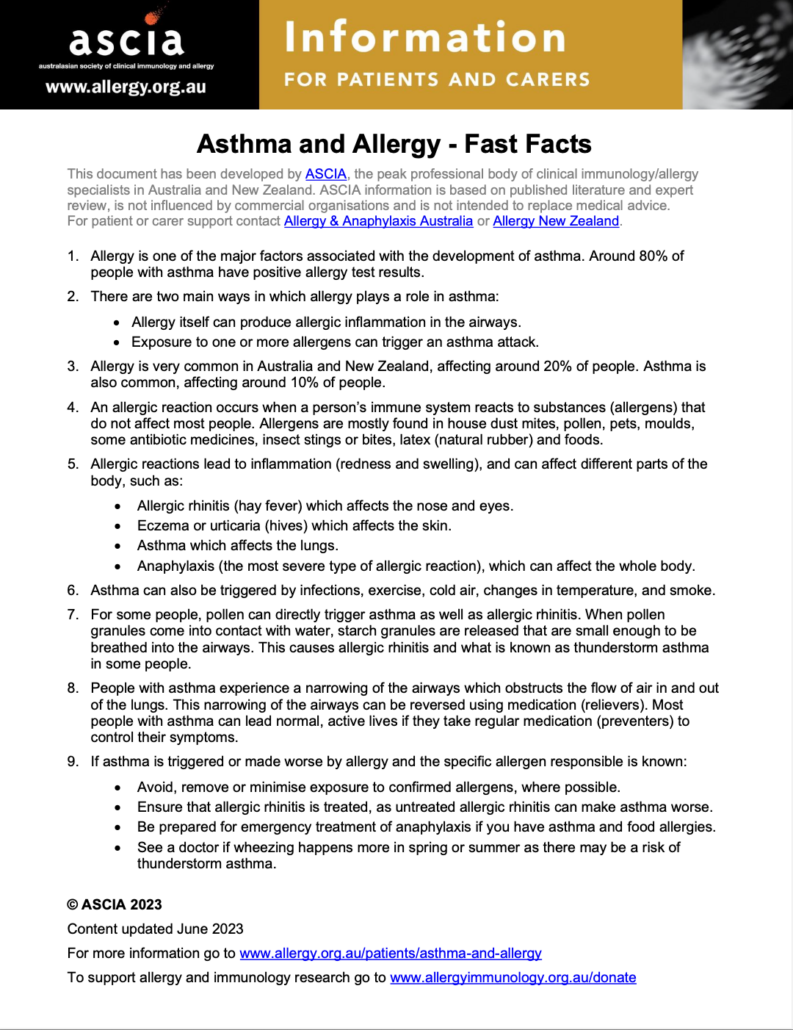
Asthma and Allergy – Fast Facts
[cited Feb 2026]
This document has been developed by ASCIA, the peak professional body of clinical immunology/allergy specialists in Australia and New Zealand.
Follow a manual added link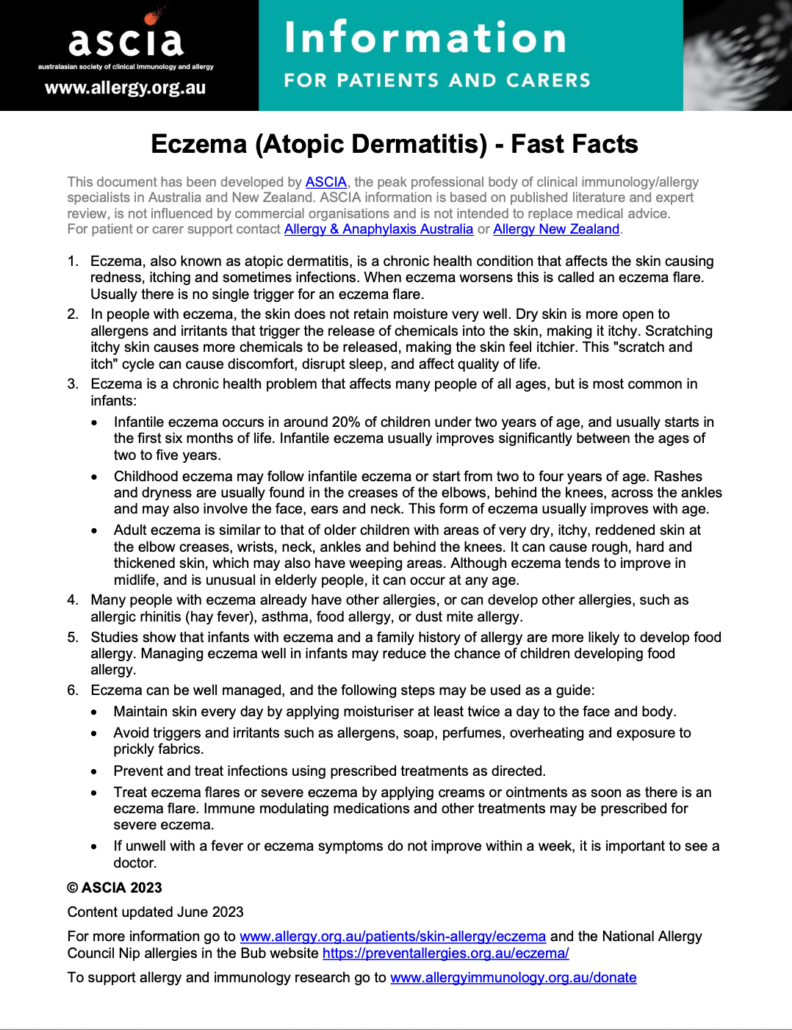
Eczema (Atopic Dermatitis) – Fast Facts
[cited Feb 2026]
This document has been developed by ASCIA, the peak professional body of clinical immunology/allergy specialists in Australia and New Zealand.
Follow a manual added link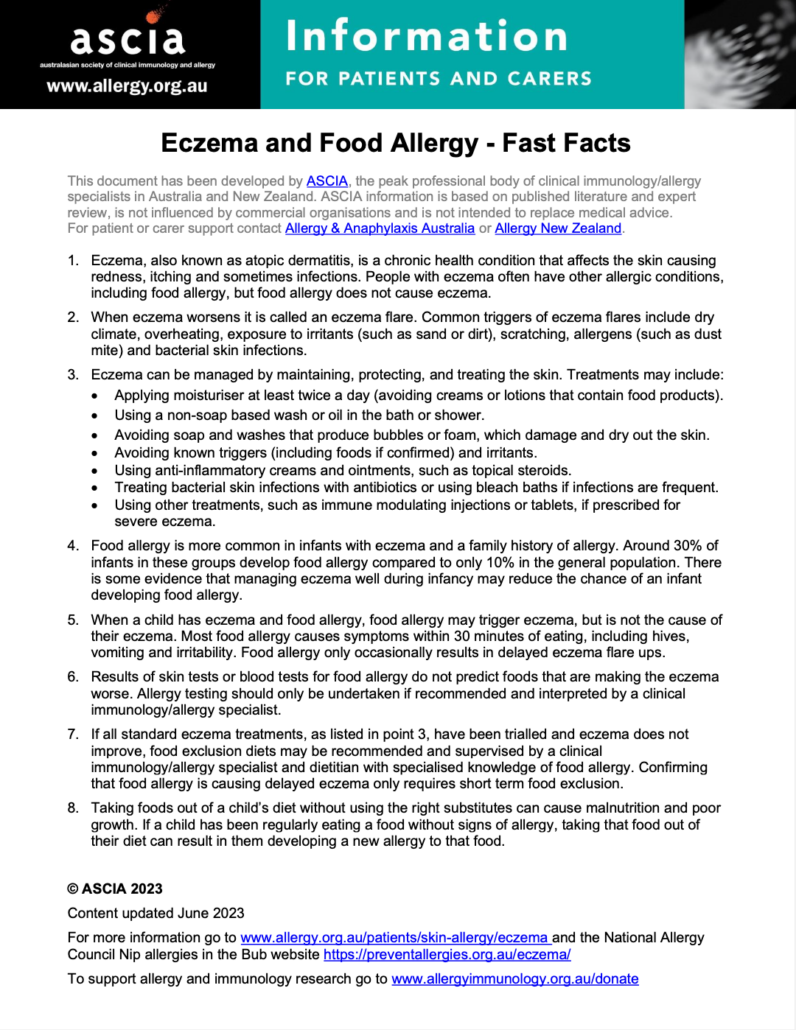
Eczema and Food Allergy – Fast Facts
[cited Feb 2026]
This document has been developed by ASCIA, the peak professional body of clinical immunology/allergy specialists in Australia and New Zealand.
Follow a manual added link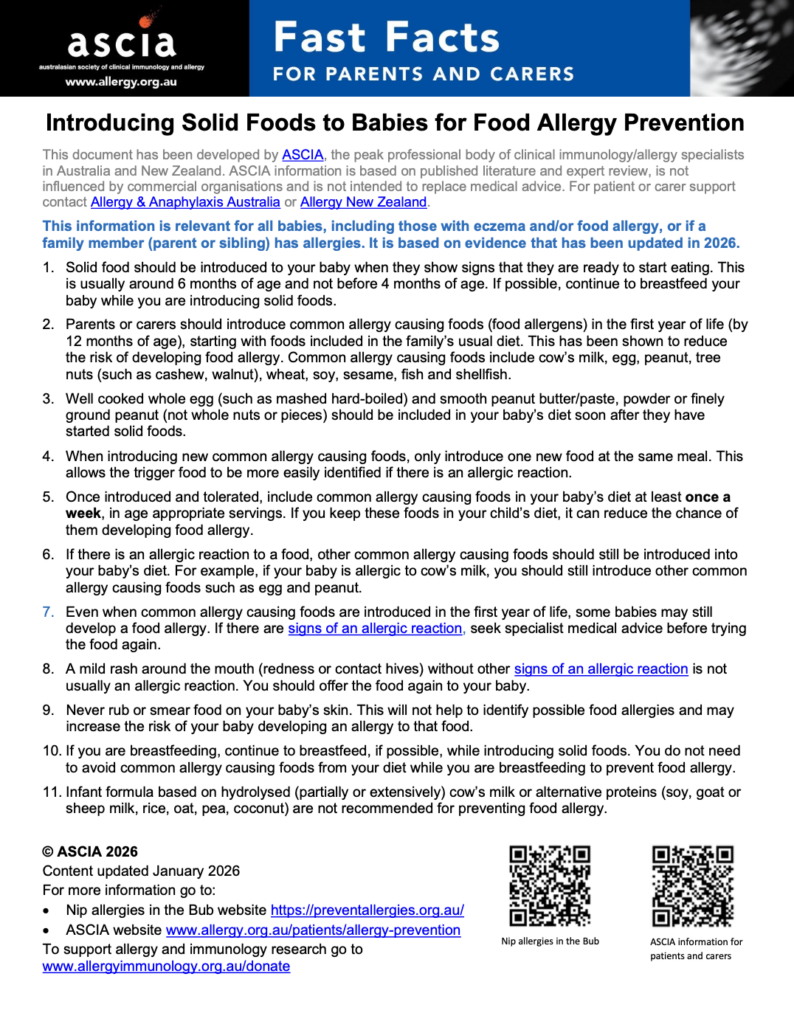
Introducing Solid Foods to Babies for Food Allergy Prevention
[cited Feb 2026]; ASCIA 2026
This information aims to provide practical advice on how to introduce solid foods to your baby, and is based on current evidence for food allergy prevention. When introducing solid foods to your baby, include common allergy causing foods by 12 months in an age appropriate form, such as well cooked egg and smooth peanut butter/paste.
Follow a manual added link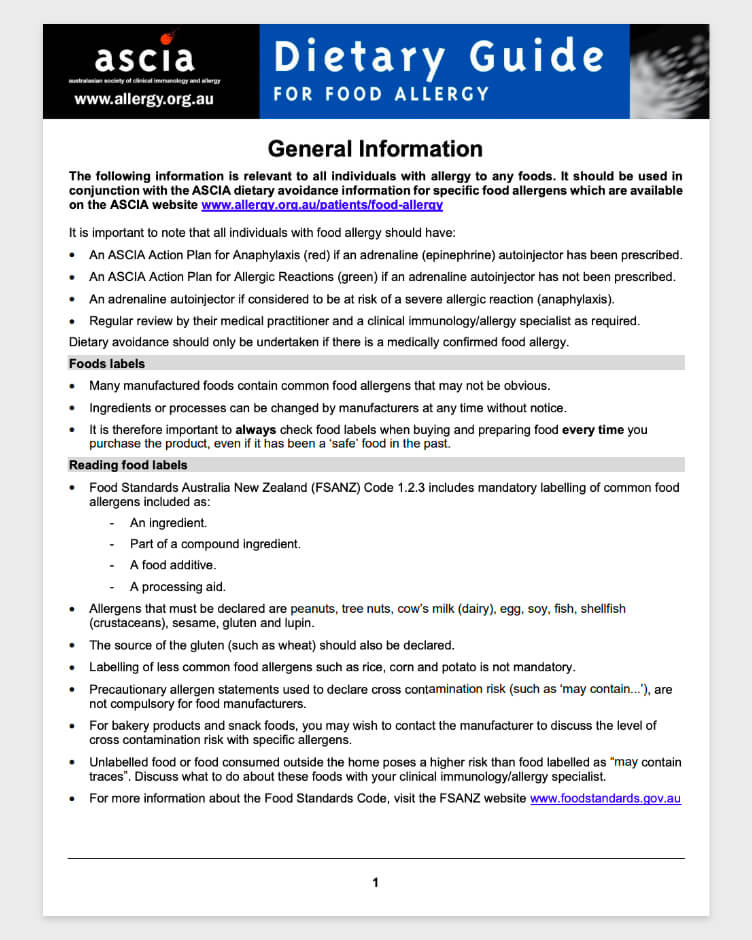
General Information
Australian Society of Clinical Immunology and Allergy. General Information [internet]. 2019 [cited Apr 2021]; ASCIA.
A general information sheet about dietary avoidance and a range of diet sheets for food allergies. It provides information on understanding allergens on food labels, ‘free from’ products, purchasing foods, eating out and possible sources of cross contamination.
Follow a manual added link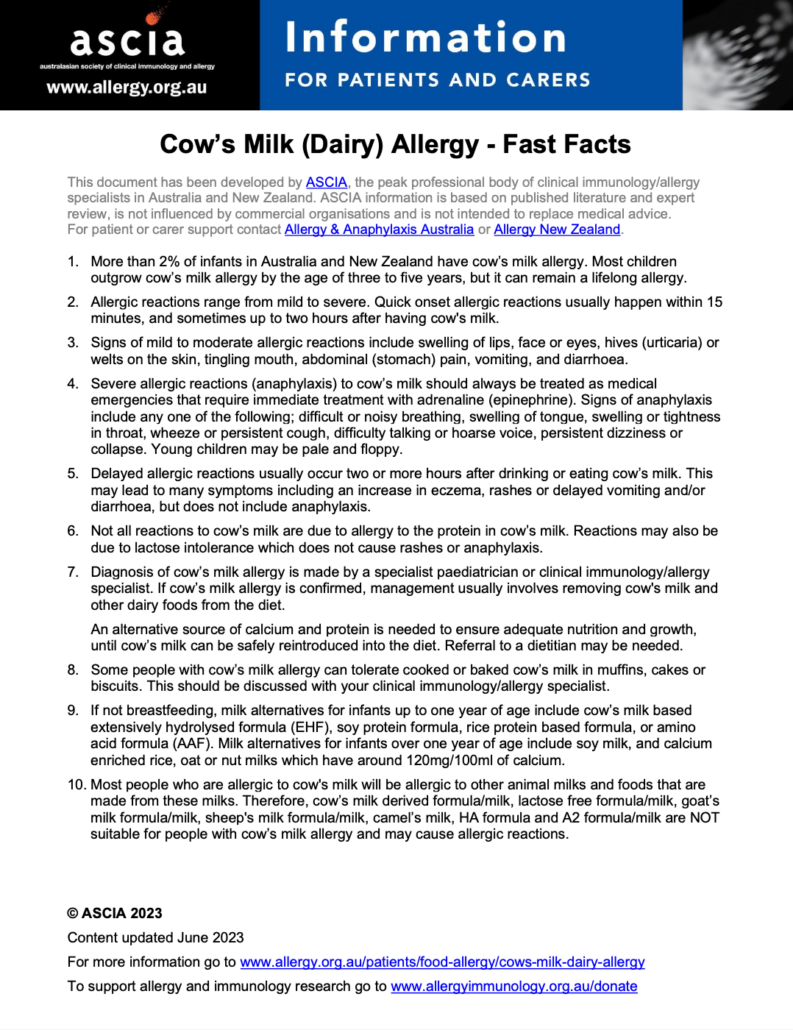
Cow’s Milk (Dairy) Allergy – Fast Facts
[cited Feb 2026]
This information sheet provides information about cow’s milk and other dairy foods being a common cause of food allergy in babies. It discusses rapid onset allergic reactions to cow’s milk, delayed reactions and how not all reactions to cow’s milk are due to allergy to cow’s protein, rather a lactose intolerance.
Follow a manual added link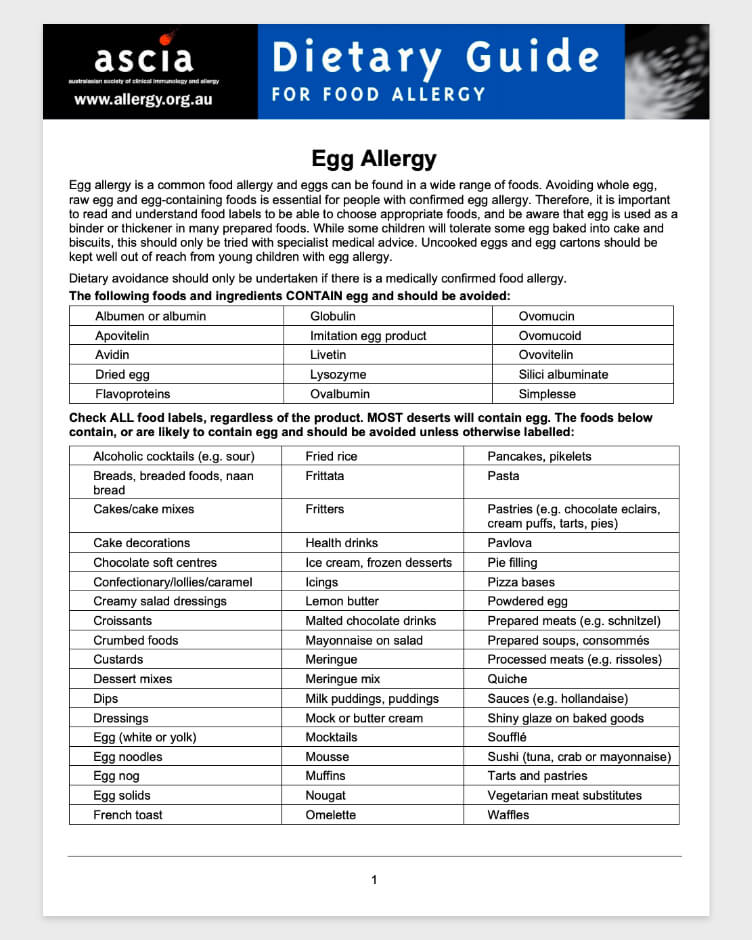
Egg Allergy
Australian Society of Clinical Immunology and Allergy. Egg Allergy [internet]. 2020 [cited Apr 2021]; ASCIA.
This dietary guide provides information on egg allergies and the importance to read and understand food labels to be able to choose appropriate foods. It is important to be aware that egg is used as a binder or thickener in many prepared foods such as cakes and breads.
Follow a manual added link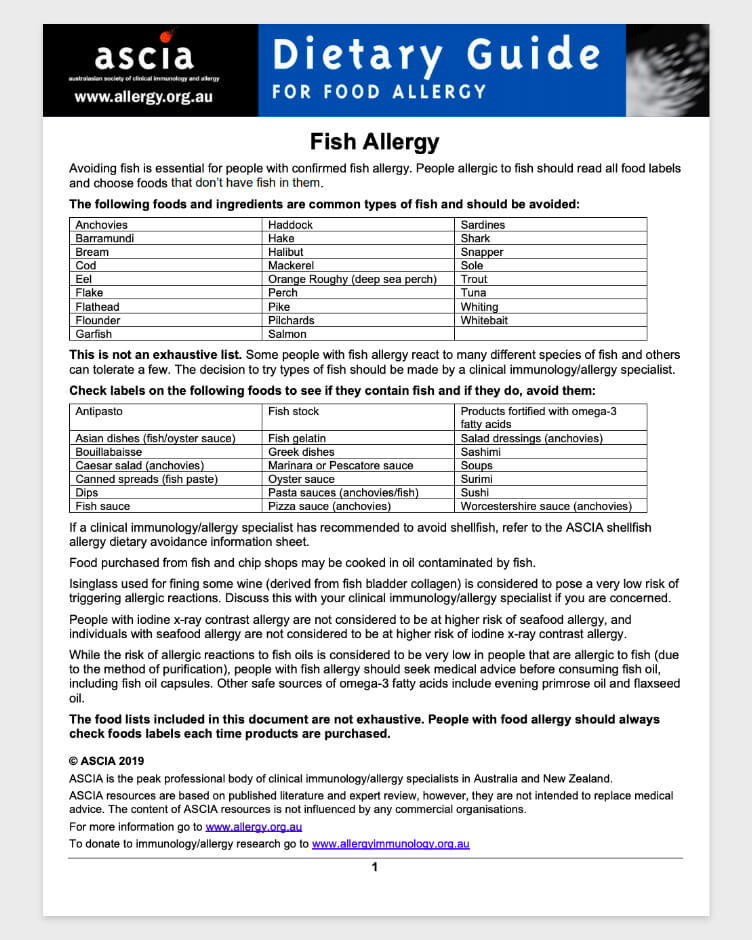
Fish Allergy
Australian Society of Clinical Immunology and Allergy. Fish Allergy [internet]. 2019 [cited Apr 2021]; ASCIA.
Avoiding fish is essential for people with confirmed fish allergy. Some people with fish allergy react to many different species of fish and others can tolerate a few. The decision to try types of fish should be made by a clinical immunology/allergy specialis.
Follow a manual added link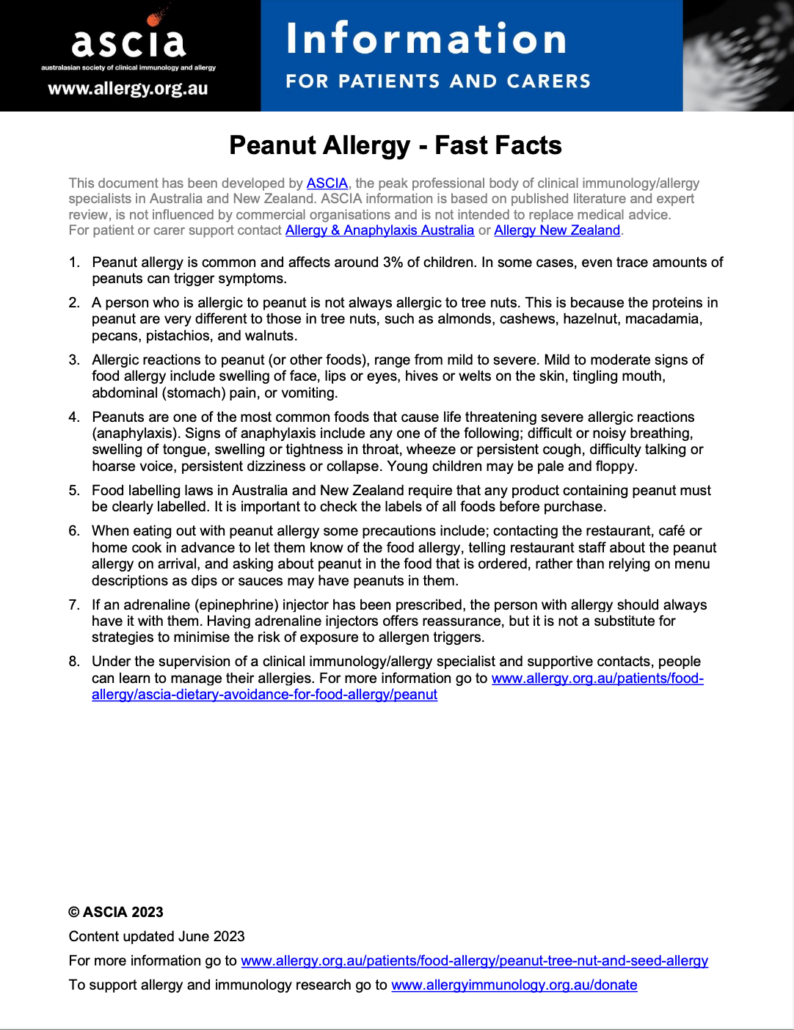
Peanut Allergy – Fast Facts
[cited Feb 2026]
Avoiding peanut is essential for people with confirmed peanut allergy. “May contain traces of peanuts” on a label indicates that the food is made in a facility that makes other foods containing peanuts. Foods that contain peanuts and should be avoided included foods such as arachis oil, beer nuts and groundnuts.
Follow a manual added link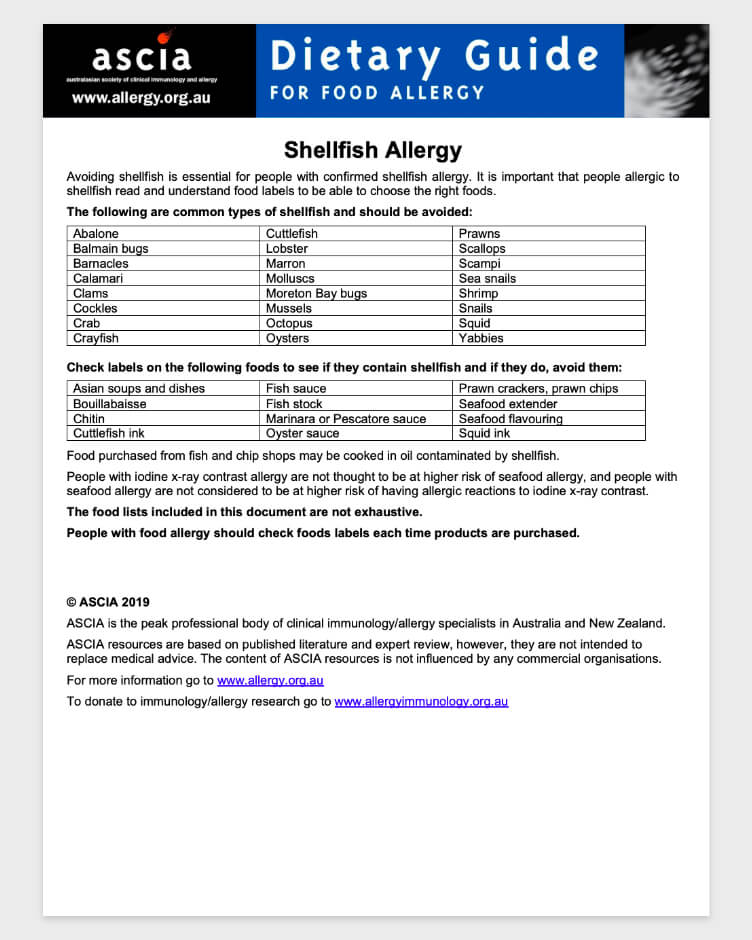
Shellfish Allergy
Australian Society of Clinical Immunology and Allergy. Shellfish Allergy [internet]. 2019 [cited Apr 2021]; ASCIA.
Common types of shellfish that should be avoided include: abalone, Balmain bugs, etc. Food purchased from fish and chip shops may be cooked in oil contaminated by shellfish.
Follow a manual added link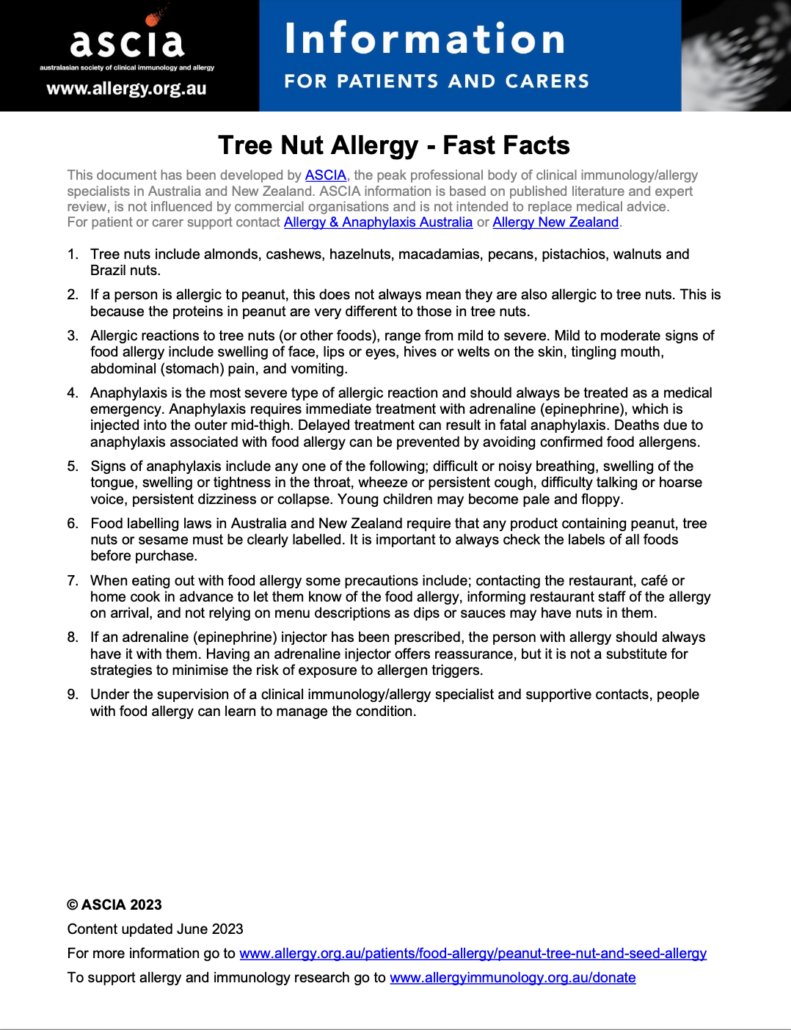
Tree Nut Allergy – Fast Facts
[cited Feb 2026]
This document has been developed by ASCIA, the peak professional body of clinical immunology/allergy specialists in Australia and New Zealand.
Follow a manual added link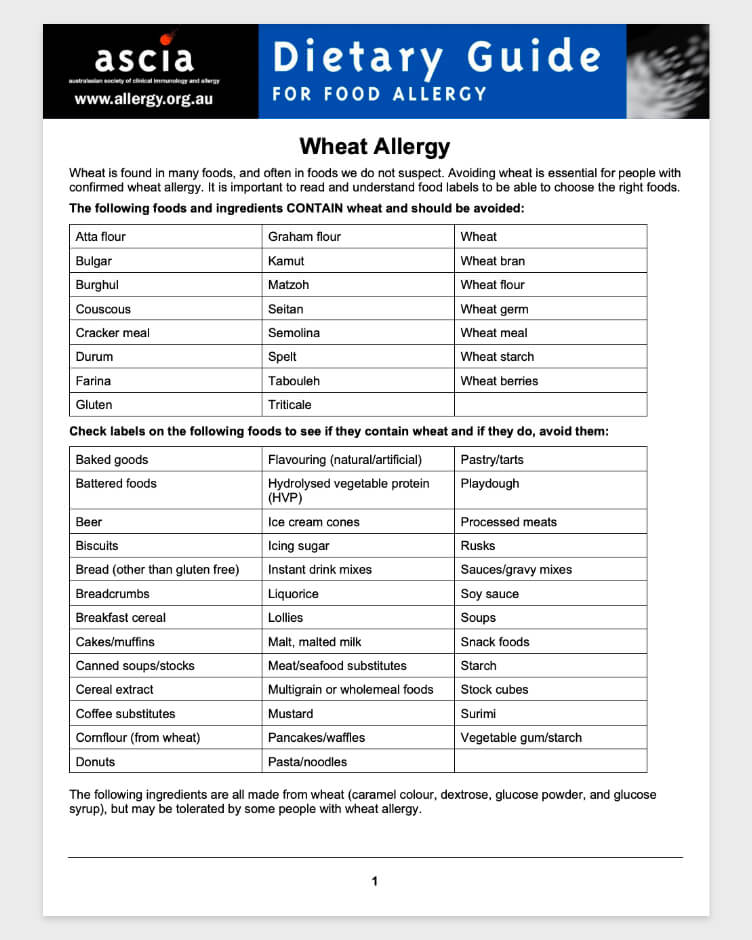
Wheat Allergy
Australian Society of Clinical Immunology and Allergy. Wheat Allergy [internet]. 2019 [cited Apr 2021]; ASCIA.
Gluten is one of many proteins in wheat, barley, oats and rye. Approximately 20% of people with wheat allergy may be allergic to other gluten containing cereals such as barley, rye or oats.
Follow a manual added link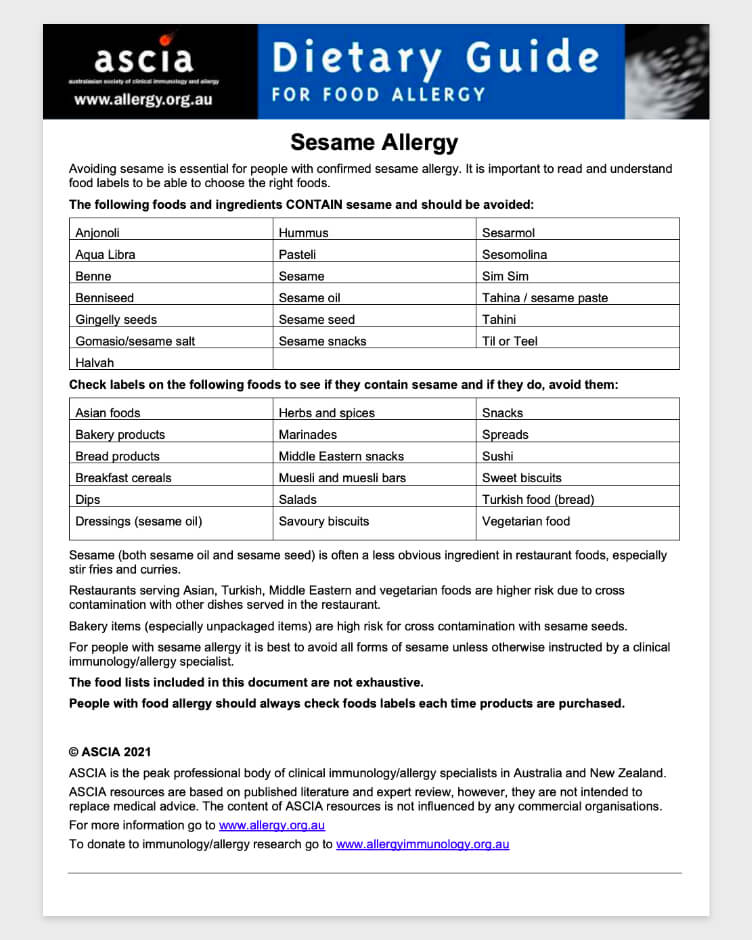
Sesame Allergy
Australian Society of Clinical Immunology and Allergy. Sesame Allergy [internet]. 2021 [cited Apr 2021]; ASCIA.
Sesame is often a less obvious ingredient. Restaurants serving Asian, Turkish, Middle Easter and vegetarian foods are higher risk due to cross contamination with other dishes served in the restaurant. Some foods containing sesame that should be avoided if one has a sesame allergy are hummus, benne, gingelly seeds and tahini.
Follow a manual added link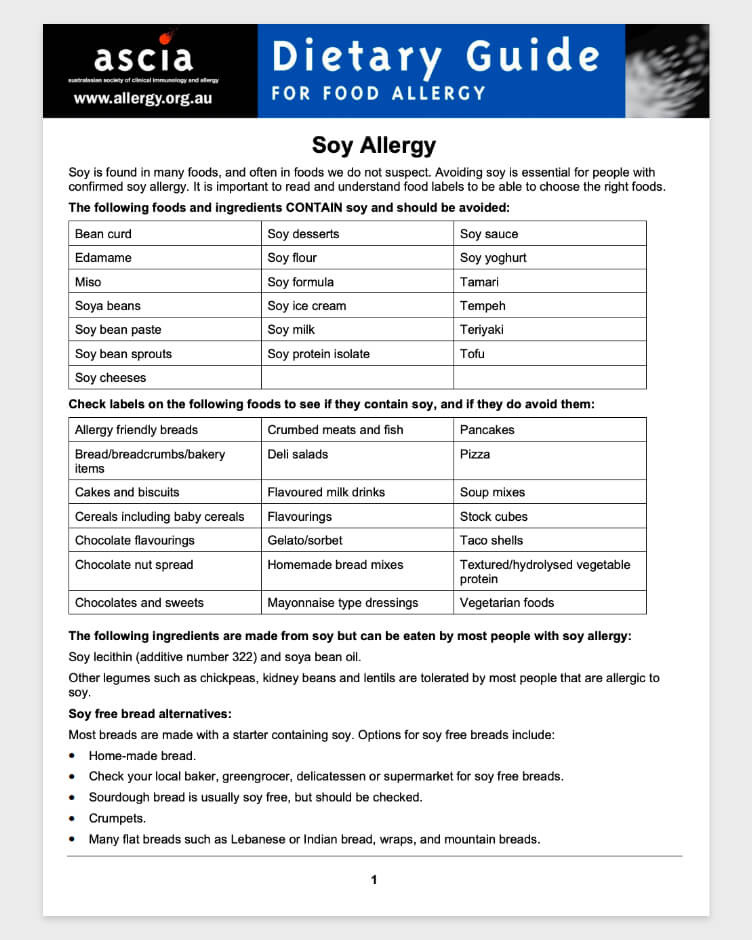
Soy Allergy
Australian Society of Clinical Immunology and Allergy. Soy Allergy [internet]. 2019 [cited Apr 2021]; ASCIA.
Soy is found in many foods, and often in foods we do not suspect, such as bread, cakes, flavourings, and pizza. Soy lecithin and soya bean oil can be eaten by most people with soy allergy. Other legumes such as chickpeas, kidney beans and lentils are tolerated by most people that are allergic to soy.
Follow a manual added link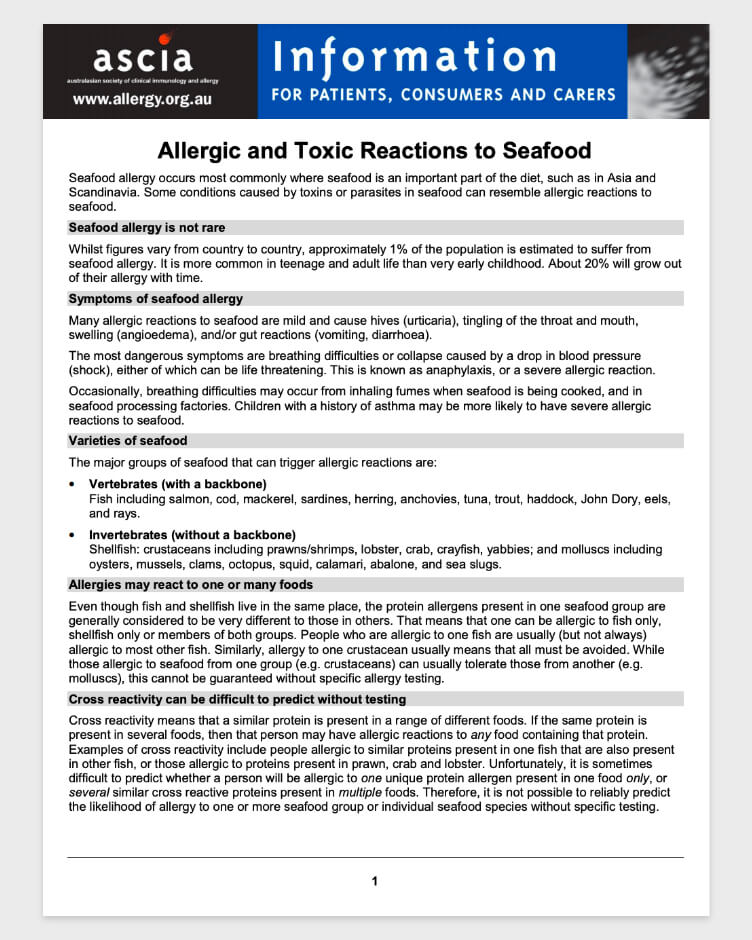
Allergic and Toxic Reactions to Seafood
Australian Society of Clinical Immunology and Allergy. Allergic and Toxic Reactions to Seafood [internet]. 2019 [cited Apr 2021]; ASCIA.
Many allergic reactions to seafood are mild and cause hives (urticaria), tingling of the throat and mouth,
swelling (angioedema), and/or gut reactions (vomiting, diarrhoea).
Follow a manual added link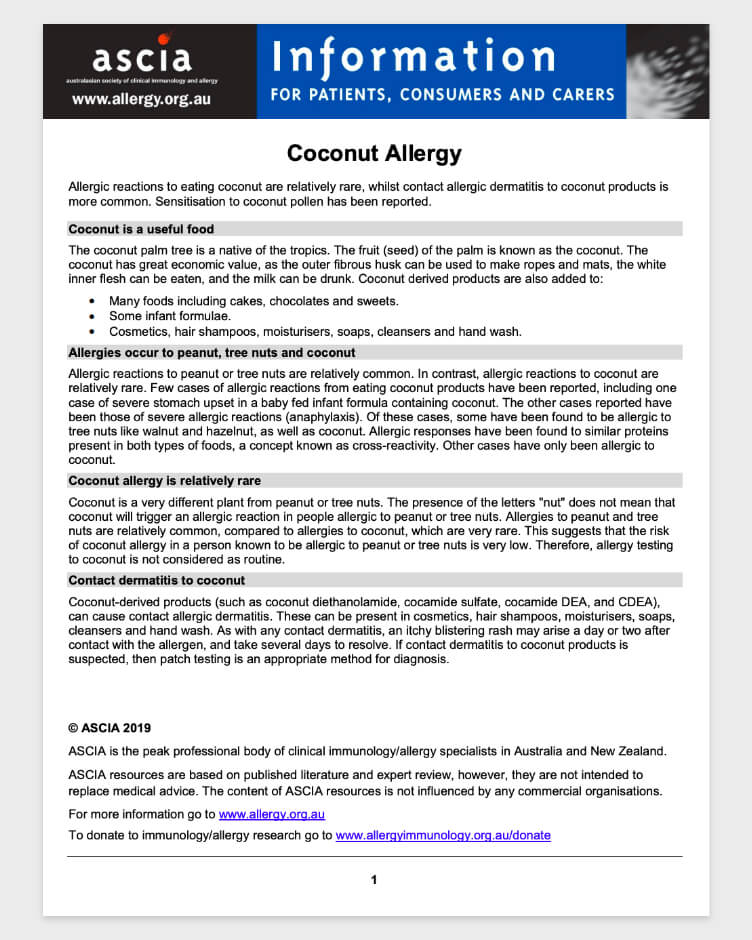
Coconut Allergy
Australian Society of Clinical Immunology and Allergy. Coconut Allergy [internet]. 2019 [cited Apr 2021]; ASCIA.
Allergic reactions to eating coconut are relatively rare, whilst contact allergic dermatitis to coconut products is more common. Few cases of allergic reactions from eating coconut products have been reported, including one case of severe stomach upset in a baby fed infant formula containing coconut.
Follow a manual added link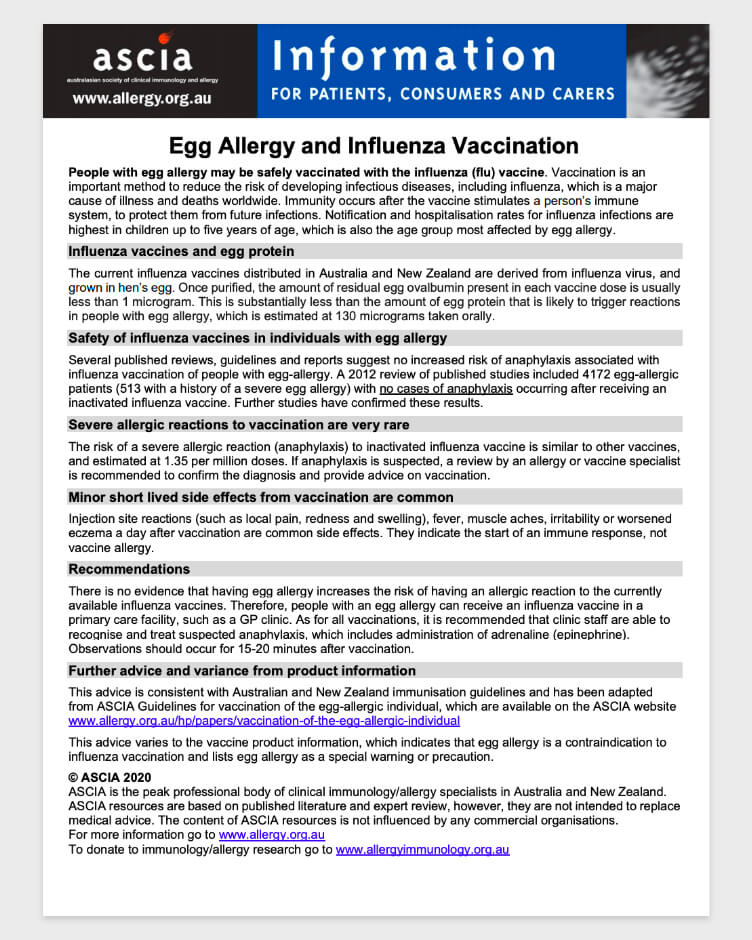
Egg Allergy and Influenza Vaccination
Australian Society of Clinical Immunology and Allergy. Egg Allergy and Influenza Vaccination [internet]. 2020 [cited Apr 2021]; ASCIA.
People with egg allergy may be safely vaccinated with the influenza (flu) vaccine. The current influenza vaccines are derived from influenza virus, and grown in hen’s egg. Several published reviews, guidelines and reports suggest no increased risk of anaphylaxis associated with influenza vaccination of people with egg-allergy.
Follow a manual added link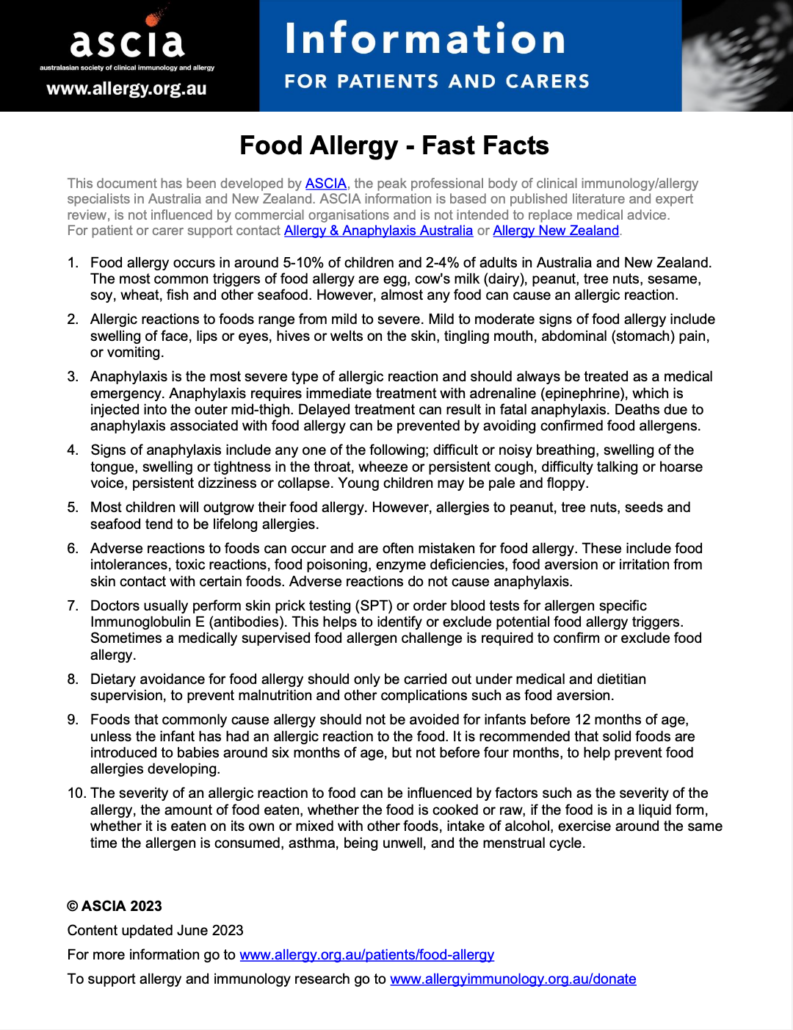
Food Allergy – Fast Facts
[cited Feb 2026]
This document has been developed by ASCIA, the peak professional body of clinical immunology/allergy specialists in Australia and New Zealand.
Follow a manual added link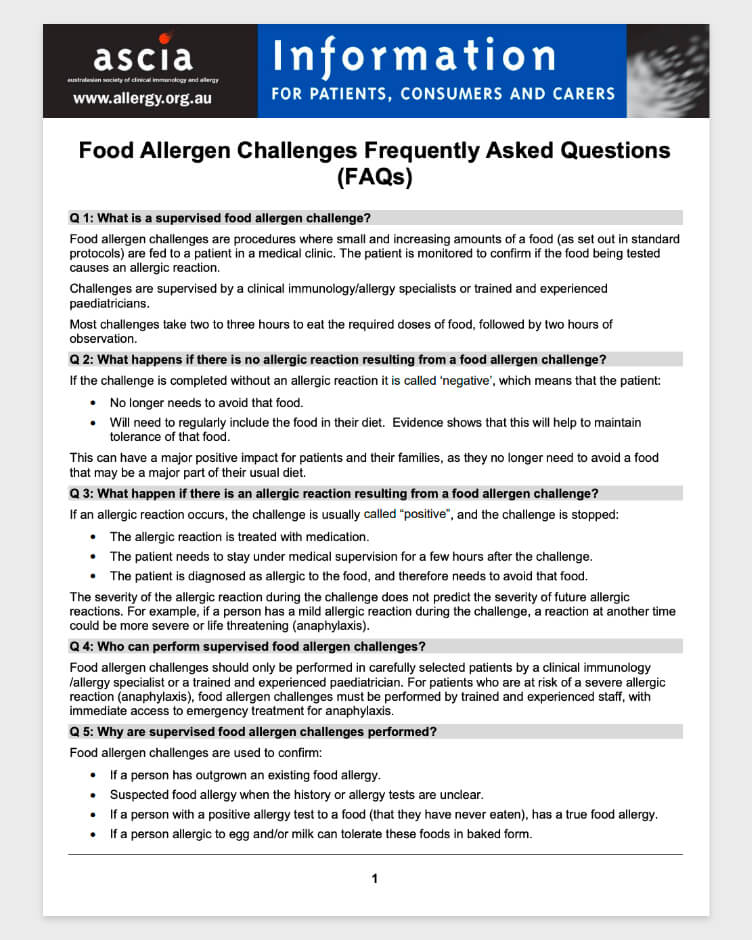
Food Allergen Challenges FAQs
Australian Society of Clinical Immunology and Allergy. Food Allergen Challenges FAQs [internet]. 2019 [cited Apr 2021]; ASCIA.
Food allergen challenges are procedures where food is fed to a patient in a medical clinic. The patient is monitored to confirm if the food being tested causes an allergic reaction. This page discusses what happens if no reaction occurs, if a reaction does occur, who can perform supervised food allergen challenges and why are they performed.
Follow a manual added link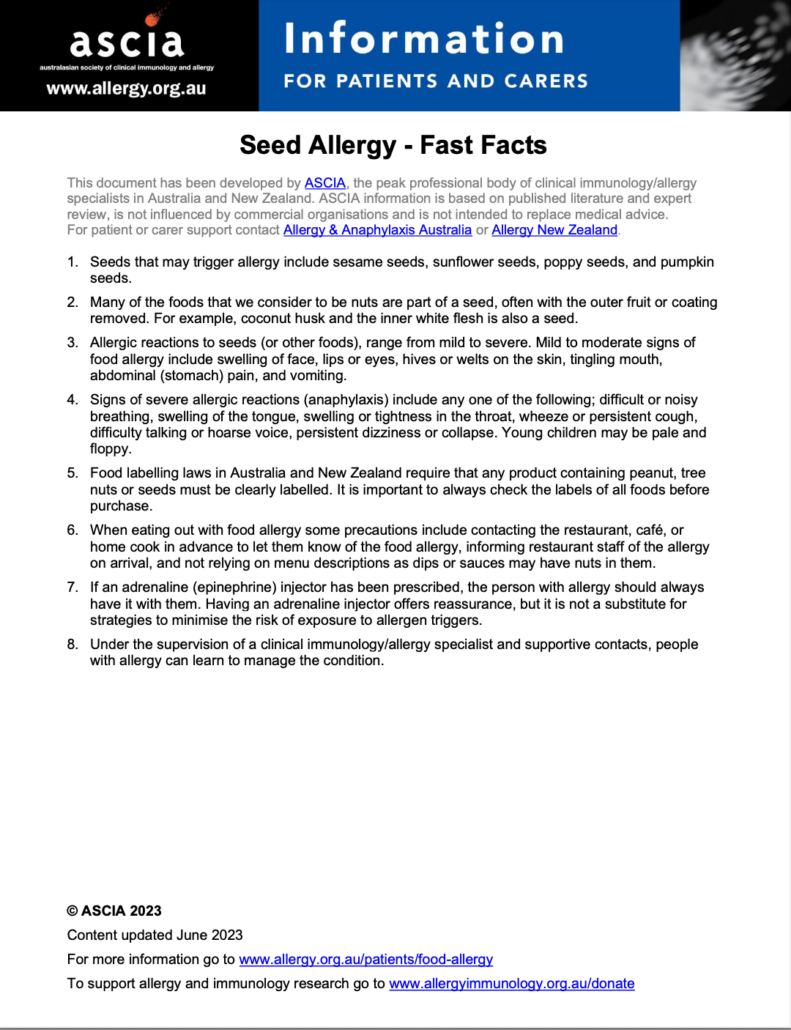
Seed Allergy – Fast Facts
[cited Feb 2026]
This document has been developed by ASCIA, the peak professional body of clinical immunology/allergy specialists in Australia and New Zealand.
Follow a manual added link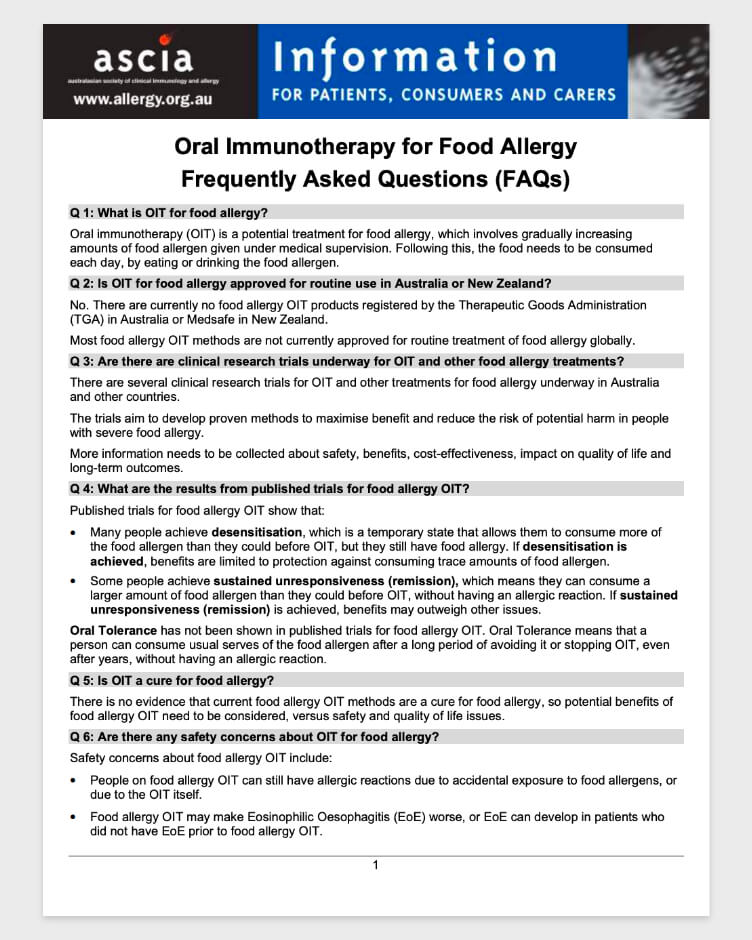
Oral Immunotherapy (OIT) for Food Allergy FAQs
Australian Society of Clinical Immunology and Allergy. Lupin Allergy FAQs [internet]. 2019 [cited Apr 2021]; ASCIA.
This document provides information on Oral immunotherapy for potential treatment for food allergy. Oral immunotherapy has not been approved for routine use in Australia or New Zealand. The document highlights the published trials for food allergy oral immunotherapy showing achievements of desensitisation and sustained unresponsiveness.
Follow a manual added link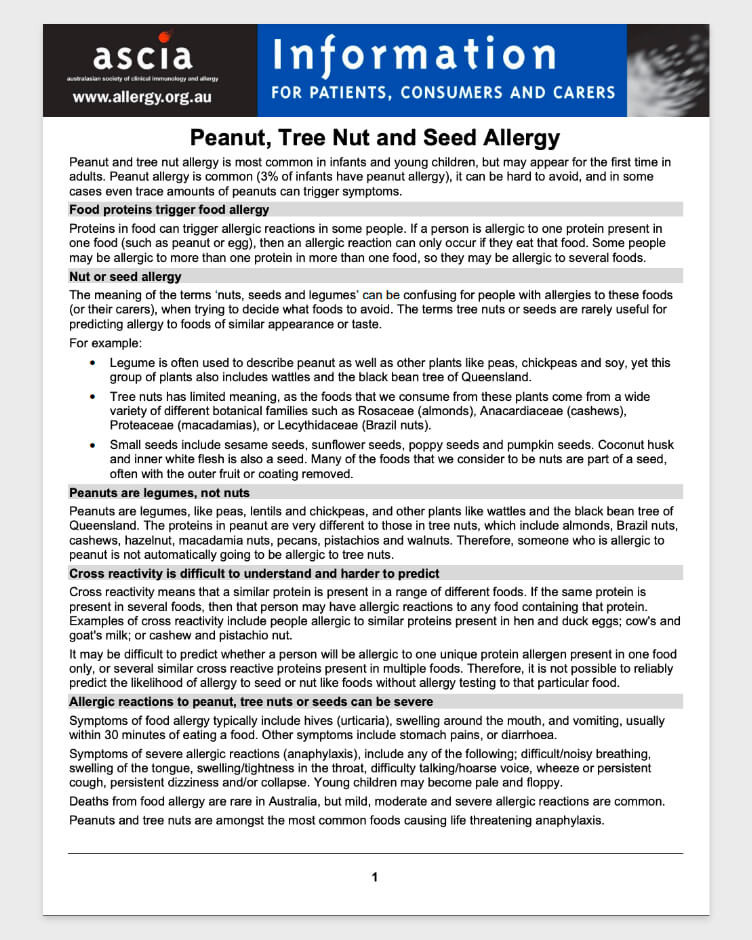
Peanut, Tree Nut and Seed Allergy
[cited Feb 2026]
This document provides information on peanut, tree nut and seed allergies. Including food proteins triggering food allergies, the difference between food terms where legumes are often used to describe peanuts, peas, chickpeas, and soy. It describes cross reactivity, where a similar protein is present in a range of different foods.
Constipation
Follow a manual added link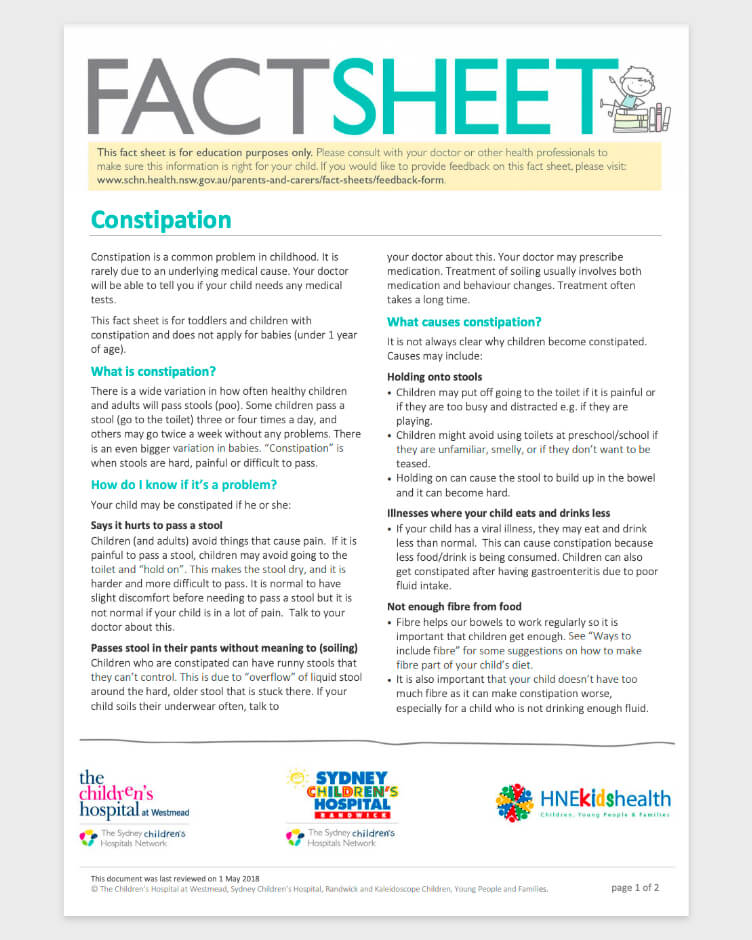
Constipation: Fact Sheet
The Sydney Children’s Hospitals Network. Constipation [internet]. 2018 [cited Apr 2021]; SCHN.
This fact sheet is for toddlers and children with constipation and does not apply for babies. It provides information on understanding constipation, it becomes a problem when it becomes painful to pass a stool, and what causes constipation. The best way to treat constipation is with medication and behavioural techniques.
Follow a manual added link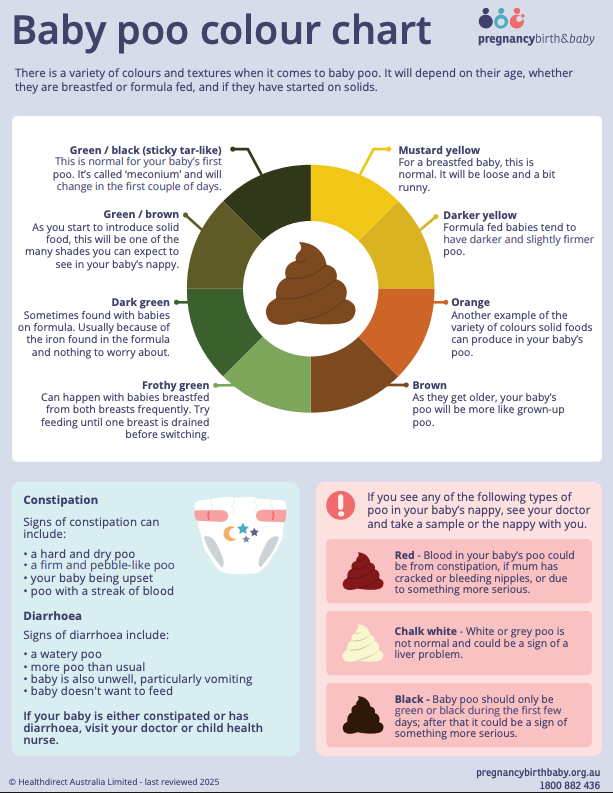
Baby Poo Colour Chart
Pregnancy Birth & Baby 2025 [cited Feb 2026]
This infographic provides a simple visual guide to baby poo colours, helping parents recognise what is normal and when medical review may be indicated.
Reflux
Follow a manual added link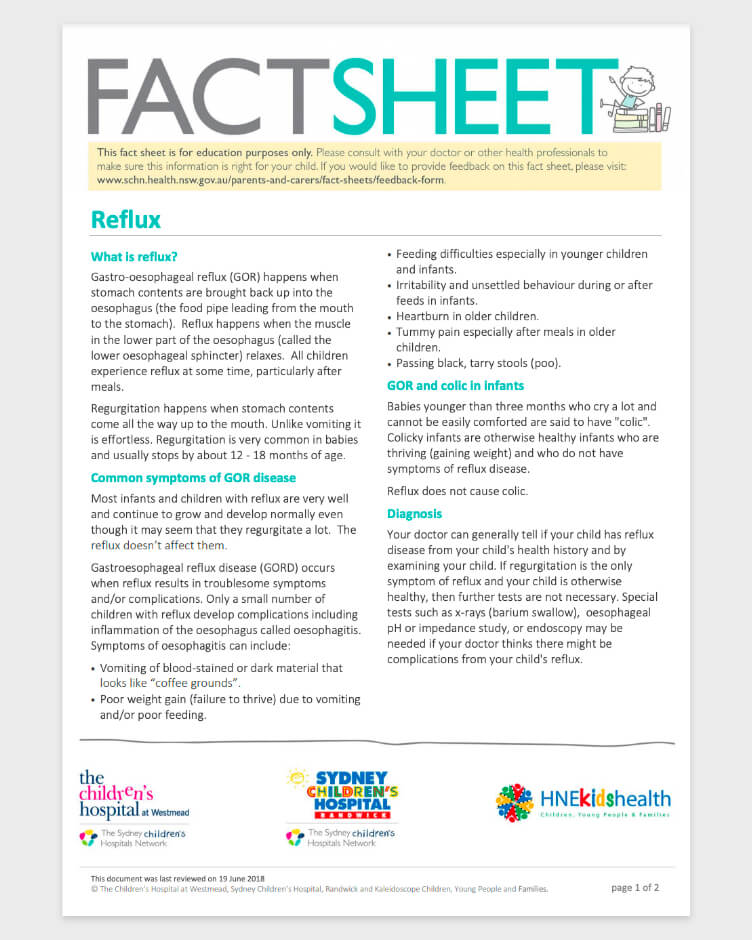
Reflux
The Sydney Children’s Hospitals Network. Reflux [internet]. 2018 [cited Apr 2021]; SCHN.
This fact sheet provides information on reflux for babies and younger children. Reflux happens when the muscle in the lower part of the oesophagus relaxes. Gastroesophageal reflux disease occurs when reflux results in troublesome symptoms and/or complications. Babies younger than three months who cry a lot and cannot be easily comforted are said to have “colic”.
Fussy Eating
Follow a manual added link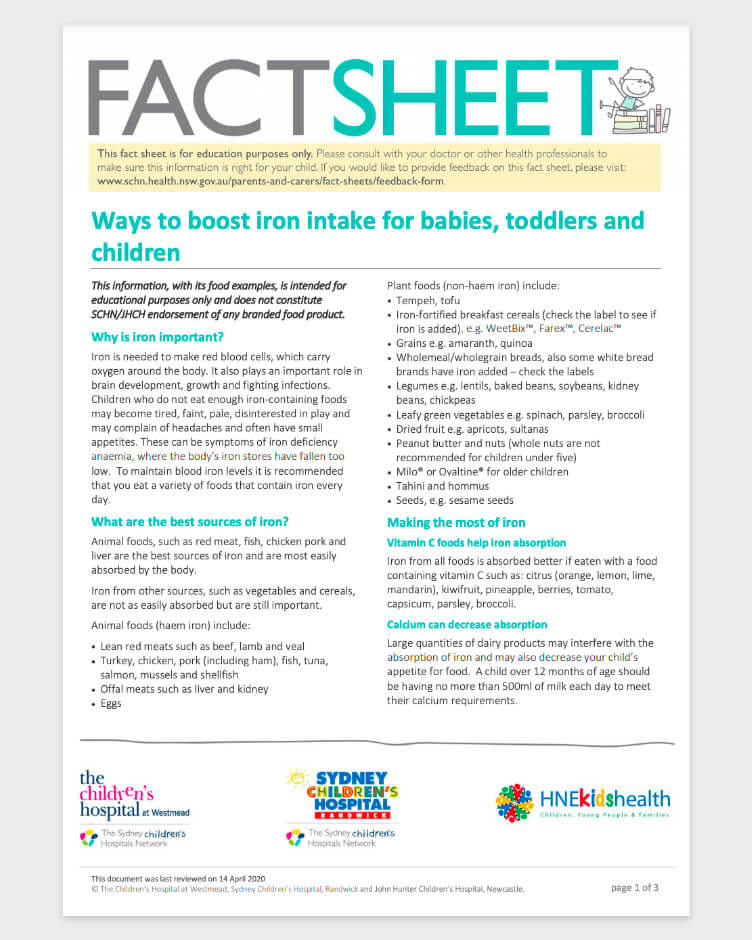
Ways to Boost Iron Intake for Babies, Toddlers & Children
The Sydney Children’s Hospitals Network. Fussy Eating in Toddlers [internet]. 2019 [cited Apr 2021]; SCHN.
This fact sheet provides information on the importance of iron and symptoms of children who do not eat enough iron-containing foods. If iron stores have fallen too low this can be iron deficiency anemia. This document includes the best sources of iron and how vitamin c and calcium impacts iron absorption.
Follow a manual added link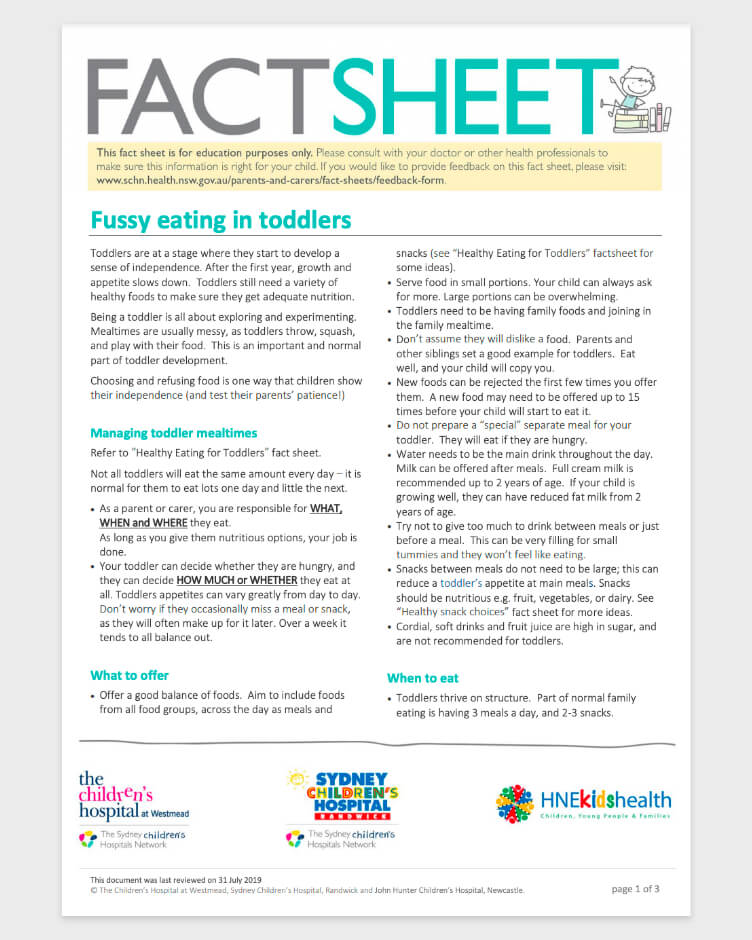
Fussy Eating in Toddlers
The Sydney Children’s Hospitals Network. Fussy Eating in Toddlers [internet]. 2019 [cited Apr 2021]; SCHN.
Being a toddler is all about exploring and experimenting. Mealtimes are usually messy, as toddlers throw, squash, and play with their food. This is an important and normal part of toddler development. Choosing and refusing food is one way that children show their independence (and test their parents’ patience)!